
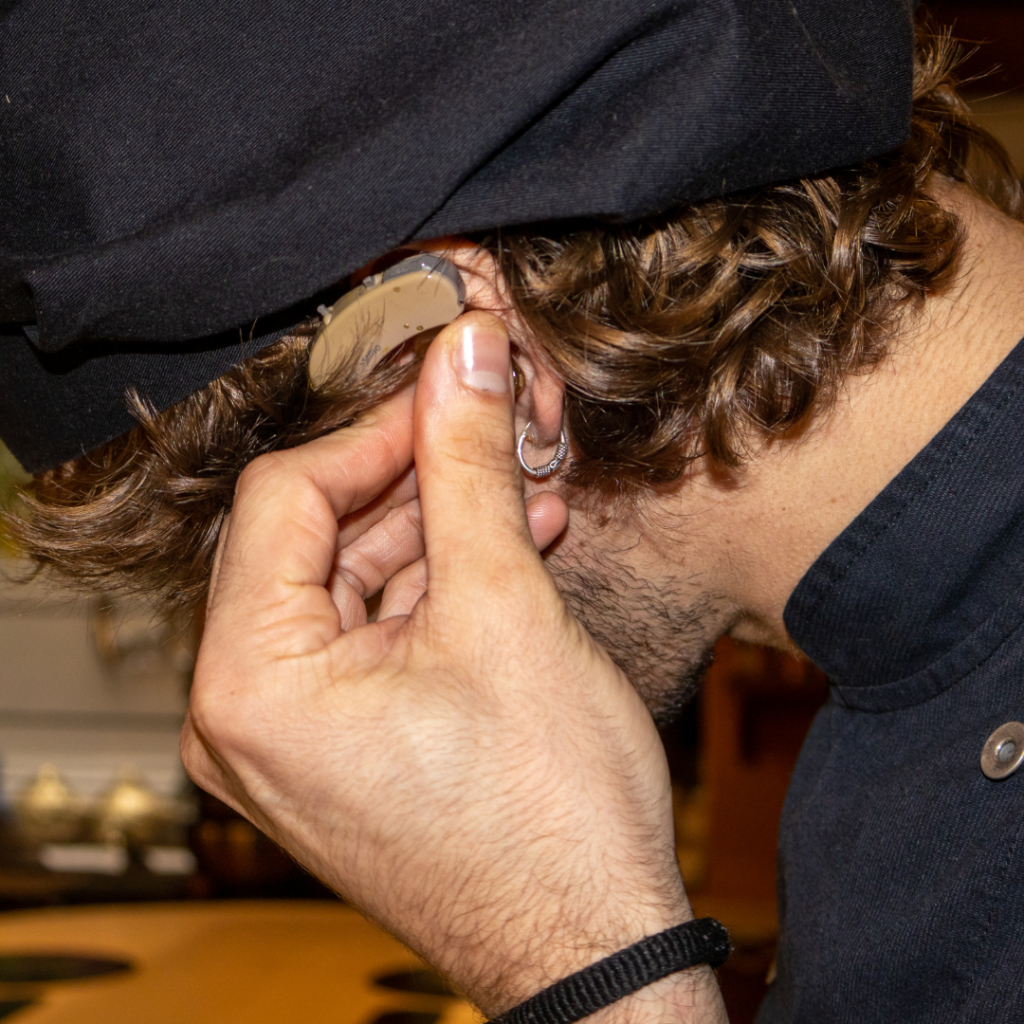
Restaurant conversations can be difficult to follow when environmental noise competes with your focus and hearing. Our practice can evaluate hearing in both quiet and noisy conditions to identify what makes these environments difficult. Once we determine the cause of difficult hearing, we can help you find personalized solutions.
Why Do I Hear Well in Quiet but Struggle in Restaurants?
Quiet rooms provide a favorable signal-to-noise ratio, meaning a speaker’s voice is much clearer than the sounds around it. Dining venues establish an entirely contrary auditory challenge. Multiple voices, music, kitchen noise, and reverberation overlap with speech, forcing the ears and brain to work harder to separate the person you want to hear.
This symptom pattern often reflects underlying high-frequency hearing loss, central processing dysfunction, or physiological aging of the auditory nerve. Dim lighting, physical tiredness, conversational distance, and divided attention exacerbate these listening deficits. Some patients pass standard pure-tone evaluations with normal scores yet exhibit substantial impairment during specialized speech-in-noise testing. Disproportionate difficulty in restaurants justifies professional clinical assessment even if your everyday home hearing appears intact.
Diagnosing High-Frequency Hearing Loss and Clarity Issues
We initiate evaluation by exploring challenging acoustic environments, acoustic trauma history, subjective tinnitus, prescription drug profiles, and unilateral ear changes.
Diagnostic pure-tone audiometry establishes the softest auditory thresholds you can perceive across standardized frequencies via air and bone conduction pathways. High-frequency hearing loss commonly presents on the audiogram as a characteristic precipitous drop in the higher frequency ranges. Extended test batteries incorporate acoustic tympanometry to rule out middle-ear pathology along with suprathreshold word-recognition testing.
Since sound-treated booths cannot replicate the chaos of a crowded dining room, speech-in-noise testing provides critical real-world insight. This procedure gauges speech-discrimination accuracy while competing multi-source noise becomes incrementally louder. Combined, these clinical findings determine whether your symptoms stem from acoustic audibility, word clarity, central noise filtering, or multifactorial causes.
Understanding Auditory Processing Disorders in Noisy Environments
Auditory processing disorders interfere with the brain’s ability to process and decipher acoustic signals arriving from the ears. The physical ear mechanisms may capture tones correctly, but the central brain pathways struggle to filter competing inputs, parse similar consonants, or interpret rapid speech. We systematically verify peripheral hearing health before establishing whether an advanced auditory-processing evaluation or medical referral serves your needs.
Effective Techniques to Hear Better in Noisy Surroundings
Minor environmental adjustments can boost speech acoustic signals and supply critical visual lip-reading cues. Before leaving home, identify quieter dining venues or plan to eat during less crowded service times. Settings constructed with comfortable booths, acoustic ceiling panels, drapery, and carpeted walkways facilitate easier communication than open venues with concrete and glass.
Practical seating strategies in the dining room:
- Reserve a table located well away from kitchen doors, active bar counters, overhead speakers, and banquet groups.
- Situate yourself with a structural wall behind you to minimize distracting ambient noise from behind.
- Ensure you sit directly across from speaking partners in an area with sufficient illumination for visual lip-reading.
- Keep the distance between speakers as short as comfortably possible.
- Direct your better-performing ear toward the companion you most need to understand.
- Prompt companions to rephrase unclear sentences with alternate terminology instead of repeating identical words.
- Verifiably confirm essential conversational facts instead of bluffing comprehension.
- Step into a quiet area for a few minutes when listening fatigue begins to compromise focus.
- Request that dining partners articulate words distinctly at an unhurried, natural speed.
- Elevated yelling distorts auditory signals and seldom improves actual phonetic comprehension.
Advanced Technology for Hearing in Background Noise
The best technology depends on the cause of the difficulty, the listening environment, and whether hearing loss is present. Prescription hearing aids fitted by an audiologist leverage directional microphone arrays, advanced digital noise reduction, and dedicated restaurant programs to focus on frontal speech while dampening background sound. Realistic expectations are vital, since even advanced hearing devices cannot completely erase background conversational chatter.
Pairing your devices with a remote wireless microphone generates a substantial improvement in the direct signal-to-noise ratio. The remote unit is attached to the speaker’s clothing or placed nearby, transmitting that voice straight into compatible hearing aids or an audio receiver. This targeted setup effectively neutralizes the negative impacts of room distance and interfering background noise.
Other useful options include:
- Dedicated table microphones engineered to capture small-group dialogue
- Integrated telecoil programs for tapping into venue-wide induction loop systems
- Mobile speech-to-text applications delivering instant visual captions during dinner
- Smart earbuds offering dedicated speech-in-noise amplification settings
- Sound-level meter applications and community-driven quiet dining guides
Our team can compare these systems, verify device compatibility with your hearing aids, and provide comprehensive training on their use.
Professional Audiological Solutions for Loud Listening Environments
A comprehensive hearing evaluation looks far beyond the common misconception of “I hear fine in quiet environments.” We examine the challenging acoustic venues, conversational setups, and noise profiles you encounter to select appropriate diagnostic tests. The diagnostic battery may encompass pure-tone thresholds, acoustic middle-ear evaluations, suprathreshold word recognition, and speech-in-noise measures. Central auditory-processing testing is considered whenever clinical intake and initial test outcomes point toward higher-order deficits.
Sudden, one-sided, or rapidly worsening symptoms may require medical evaluation by an ear, nose, and throat physician. Individualized diagnostic care pinpoints the precise physiological etiology rather than merely blaming restaurant noise for communication struggles.
Arrange a Hearing Evaluation With Us Now
If noisy restaurant gatherings leave you struggling to follow dialogue, pulling away, or feeling completely drained, schedule an audiological evaluation with our team. We provide proven treatments to enhance your hearing in noisy environments, offering hearing aid fine-tuning, specialized assistive accessories, and individualized auditory therapy.
Reach out to our audiology clinic today to schedule an evaluation and begin enjoying clear, effortless conversations.